Alumna supporting educational development in rural Mongolia through sustained commitment
Posted: 12 August 2026
Solongo Batnasan completed a Master of Inclusive and Specialised Education at Flinders University in 2024 with the support of an Australia Awards Scholarship. Solongo has dedicated her career to improving educational opportunities for children in Uvs Province, a remote region in western Mongolia that is 1,300 kilometres from the capital city of Ulaanbaatar. Prior to studying in Australia, she worked as an English and Russian teacher for 21 years. Throughout her teaching career, she supported students who experienced educational disadvantages caused by geographical isolation, limited resources and unequal access to quality learning opportunities.
While working as a teacher, Solongo actively engaged in volunteer initiatives to support disadvantaged groups, including orphaned children, older adults without family support and students with disability. Through these experiences, she developed a deeper understanding of the barriers faced by children with diverse learning needs.
Her decision to pursue advanced study in Australia was motivated by the desire to bring home evidence-based practices from international education systems and create more equitable learning opportunities in Mongolia. In 2023, Solongo earned bronze‑level status through the Scholar Champions Program, an initiative of Australia Awards – South Asia & Mongolia that recognises scholars for their commitment to professional development. Points towards champion levels are awarded based on attendance and active participation in events organised by the Australia Awards – South Asia & Mongolia team.
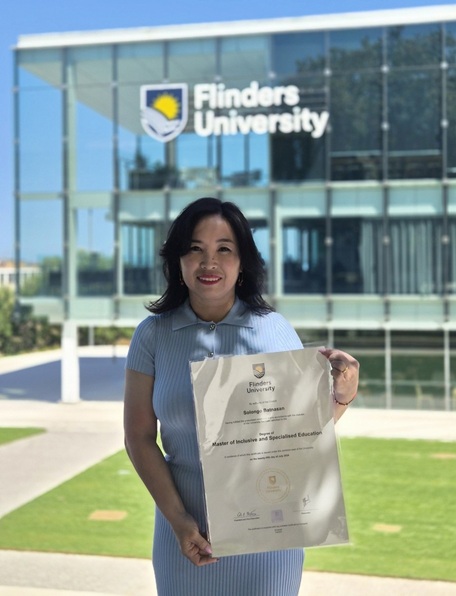
Solongo proudly holding her master’s degree certificate in front of her university.
After completing her master’s degree in 2024, Solongo became the only professionally qualified specialist in Inclusive and Specialised Education in her rural province. This unique expertise has enabled her to support schools, educators and communities in implementing more inclusive educational practices.
Since returning to Mongolia, Solongo has continued to expand her work in inclusive education. In collaboration with the Government of Uvs Province, she successfully led a project to renovate and enrich the library of a disadvantaged school located on the outskirts of Ulaangom, a soum (administrative district) where many students face limited access to educational resources.
To further extend this work, Solongo applied for an Australia Awards Alumni Grant in 2025, and her project Tea & Tales was selected for funding. The initiative supported students in developing positive reading habits and strengthening literacy skills. Solongo successfully implemented the project for 96 students, enriching the school library with new reading materials, promoting a culture of reading and encouraging healthy learning environments by providing reusable water bottles.
Solongo also received support from Australia Awards’ Women’s Leadership Program in Mongolia for the “UU” Project, a community development initiative launched to raise public awareness about healthy hydration habits for children, especially preschoolers. This project operates in Ulaanbaatar, as well as the Darkhan, Uvs, Khentii and Selenge provinces, directly reaching over 600 preschoolers across nine kindergartens. Solongo supported the project in the capacity of finance and fundraising manager.
The “UU” Project directly led to the Mongolian Government adding ‘Water bottle (for children)’ to section 10, ‘Hygiene supplies’, in the ‘List of school supplies, educational and hygiene items for children attending preschool education’. This list was originally approved as an annex to Order No. A/273 of the Director of the General Authority for Education on 24 August 2023, and the amendment was finalised on 15 August 2025, in accordance with Order No. A/192. As a result of this initiative, more than 265,000 preschool children across the country now use water bottles.
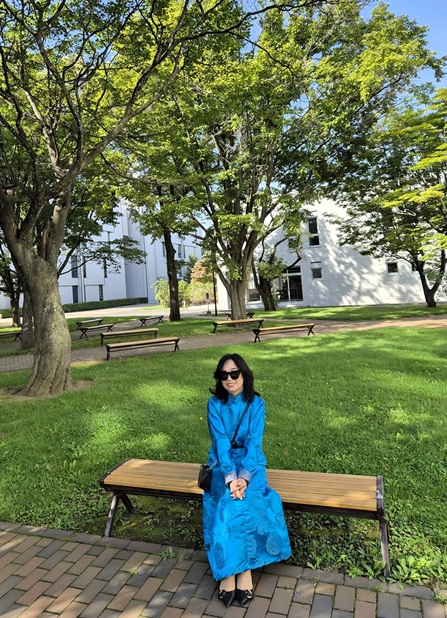
Solongo photographed during her Scholarship in Australia.
Drawing on knowledge and practices gained from the Australian education system, Solongo has worked to adapt and implement effective educational approaches within her local context. She established a community centre that supports children, youth and families by creating inclusive learning opportunities and promoting holistic child development. She also provides ongoing mentoring to local teachers, strengthening their capacity to apply inclusive teaching strategies.
Throughout her career, Solongo has actively promoted volunteerism as a pathway for developing social responsibility among young people. She has initiated community projects such as the Warm Boots Campaign and Back-to-School Supplies Drive, providing essential support to children from disadvantaged families. While studying in Australia, she also initiated a project supporting children with autism in her home community. Through fundraising activities, including organising a nationwide English competition in Mongolia, she raised resources to provide individualised educational support and learning materials for five children with autism, based on their specific needs.
Beyond providing direct assistance, she encourages her students to participate in volunteer activities, helping them develop empathy, compassion, civic responsibility and leadership skills through meaningful engagement with their communities.
Since 2025, Solongo has expanded her community leadership work by organising monthly events aimed at empowering rural women. These sessions address important topics such as women’s health, leadership development, personal growth, learning from successful female role models within Uvs Province and prevention of gender-based violence. Through these initiatives, she seeks to strengthen women’s confidence, leadership capacity and participation in community development.
Most recently, in recognition of her leadership and commitment to public service, Solongo has been elected as a representative to the Uvs Province Citizens’ Representative Khural (Provincial Parliament). In this role, she advocates for policies that promote inclusive education, improve educational equity, and strengthen support systems for children with disability and vulnerable groups. Her position allows her to contribute to local decision-making processes and ensure that the voices of marginalised communities are considered in education and social development policies.